 HECATE
Lighting the path to the right molecule.
Choose your patients, define your risk, design the drug.
Deep dark space
Untested ground.
In the light
Validated biology, very crowded.
At the edge
Next to clinical truth, but less crowded.
Where a readout is coming
A bet either way: a win lights it up, a loss tells you where not to walk.
Design the drug
Bispecifics, ADCs and T-cell engagers are all validated in the clinic.
The right molecule
Matches the Therapeutic Profile.
“I spent six years at Merck telling AI companies: if you think your software will make a better drug cheaper, then make a better drug cheaper.”
Which molecule to make is often decided late in the game.
Platforms pick the target. The plan comes after the hiring. Target research starts at the readout. So it ends up being a scramble.
About 90% of drugs that reach the clinic fail, and 40 to 50% of those fail on efficacy. Wrong idea, not a badly made molecule.
Every founder believes their idea is the best one. Naming a lead is easy, picking the right one is everything.
Most AI in biotech helps make the molecule right. Our AI helps make the right molecule.
We don’t guess the unknown. We measure how far it is from the known.
A positive trial doesn’t just prove one drug. It lights up everything near it. DESTINY didn’t only prove Enhertu; it made every DxD ADC on a HER2-like target more likely to work.
Untested ground is dark space. Far from the light, the odds are close to zero. At the edge, they’re good. Or you stand where the light is about to come on, next to a trial that’s due to read out, and you’re ahead of everyone.
How far you stand from the light is your risk appetite.
A torch lights more than one road: one target’s success lights the ADC, the bispecific and the T-cell engager around it.
Most biotechs shoot the moon. It’s all or nothing. Even with one or two molecules ahead of us in the race, a differentiated molecule can still hold immense value.
Start with the Therapeutic Profile, then build the drug to match.
Mechanism of action, clinical data and the patient selection all feed into the Therapeutic Profile.
The Scientific Mind Engine is Hecate’s internal system for evaluating therapeutic opportunities. AI agents organize evidence and challenge assumptions; human scientific judgment sets direction.
Bispecifics, ADCs and T-cell engagers are all validated in the clinic. If it’s made of protein or it’s a conjugate, it’s in scope. De novo design too, if it makes sense.
Fifteen years inside the drug pipeline.
Drew Waight, PhD, is a named inventor on four clinical-stage biologics. He holds 13 patent families (24 granted patents) and has 24 papers with 1,500+ citations.
| Molecule | What it is | Where | Stage | Role |
|---|---|---|---|---|
| Fetrastobart vedotin | PD-L1 ADC | Seagen, now Pfizer | Phase 3 | Inventor |
| MK-8294 | Conditional T-cell engager | Merck / Janux | Phase 1 | First inventor |
| MK-6837 | TROP2 ADC | Merck | Phase 1 | Inventor |
| SI-F019 | ACE2-Fc | Systimmune | Phase 1 | Inventor |
Seagen
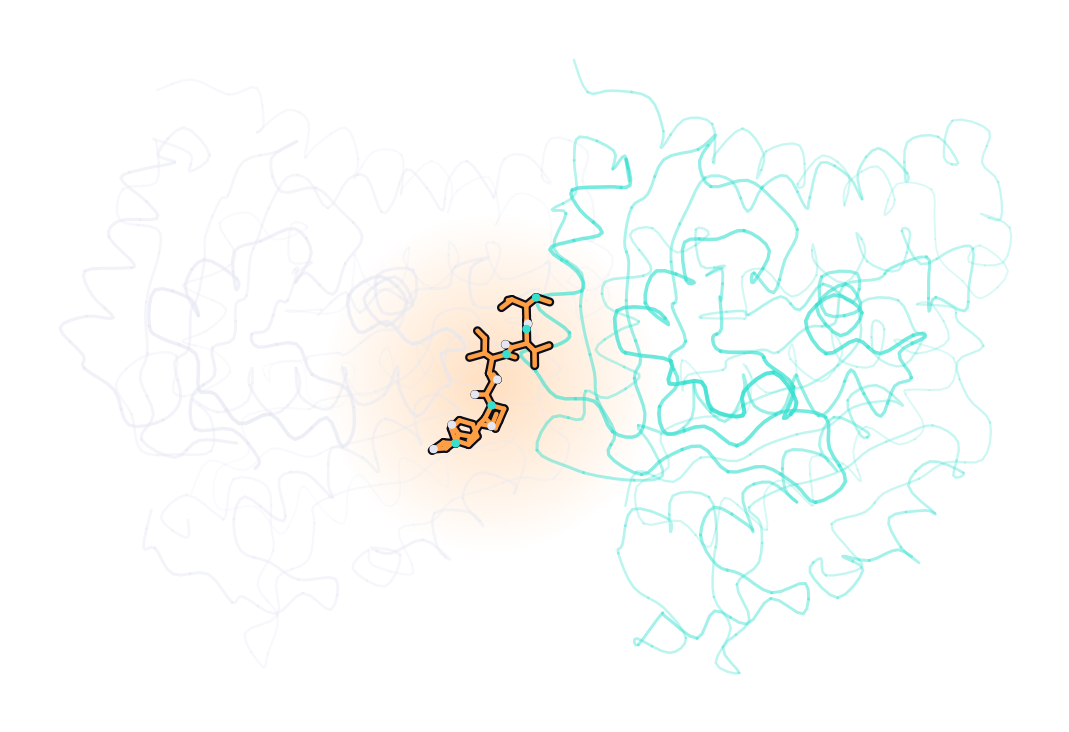
Lead computational and structural scientist on the design of novel payloads, solving 14 tubulin–payload crystal structures. He engineered three ADCs that reached the clinic, and is first inventor on a site-specific conjugation patent granted in five countries.
Systimmune
Led and rebuilt the protein engineering and antibody discovery groups and co-invented new multispecific T-cell engager formats (4 patent families).
Merck
Co-led 4 programs and was protein engineering lead on 4 more. As Senior Director of Machine Learning he led the AI/ML initiative that produced BioPhi and developability models used in 15+ programs.
Training
Structural biologist. NYU PhD, UCSF postdoc.